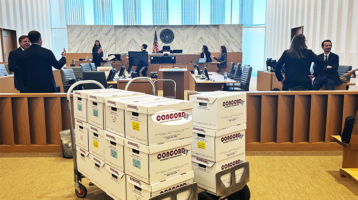
A corporate ediscovery provider is often brought in after the stakes have already risen: a preservation notice has arrived, a regulator needs records, a key custodian has an iPhone full of relevant messages, or trial deadlines are closing fast. At that point, the question is not whether a vendor has a review platform. The question is whether that provider can preserve evidence, control risk, move volume, and produce defensible work without creating another management problem for the legal team.
For corporations, law firms, and government agencies, eDiscovery selection is an operational decision with legal consequences. A missed source, weak chain of custody, inconsistent Bates labeling, or late production can affect more than a project schedule. It can affect negotiation leverage, court credibility, and the cost of the matter.
What a Corporate eDiscovery Provider Must Handle
Corporate matters rarely remain confined to one data source or one workflow. A commercial dispute may begin with email and shared drives, then expand to text messages, cloud repositories, paper files, legacy databases, and documents held by third parties. Investigations can require rapid collection from departing employees, executive devices, or locations where normal IT access is limited.
The right provider should be equipped to manage the full evidence lifecycle: identification, preservation, collection, processing, review, production, and trial preparation. That does not mean every matter needs every service. A narrowly defined employment matter may require targeted email collection and attorney review. A government investigation or bet-the-company litigation may require forensic collection, large-scale processing, rolling productions, physical file conversion, and trial exhibits under a compressed schedule.
A provider that only handles one stage of the process can create handoffs at the exact moment control matters most. Each transfer between a collection vendor, processing vendor, review team, copy center, and trial graphics provider adds coordination work and potential exposure. A unified provider is not automatically the right answer, but it can reduce friction when electronic and physical evidence must be managed together.
Start With Defensibility, Not Software
Review technology matters, but software alone does not establish a defensible process. Legal teams should ask how collections are planned, documented, verified, and secured. The answer should be specific enough to show that the provider understands the difference between collecting files and preserving evidence.
Forensic data collection is particularly important when mobile devices, personal devices, deleted material, metadata, or disputed authenticity are involved. An iPhone collection, for example, is not simply an export of visible messages. Collection choices can affect available data, timestamps, attachments, system artifacts, and the ability to explain the process later. The provider should be able to describe its collection method, preservation practices, documentation, and chain-of-custody controls in terms counsel can use with confidence.
The same discipline applies to email. Targeted mailbox collections may be appropriate when the scope is known and time is short. Broader preservation and collection may be necessary when the facts are evolving. There is no universal collection method that fits every matter. What matters is whether the provider can explain the trade-offs, preserve relevant data appropriately, and adjust scope under counsel’s direction.
Assess Security and Chain of Custody Early
Security questionnaires are necessary, but they should not be the end of the assessment. Sensitive legal data can include trade secrets, personal information, privileged communications, medical records, financial information, and government records. The provider must have practical controls for receiving, storing, accessing, transferring, and returning or disposing of information.
Ask how access is limited by matter and role, how transfers are documented, where data is hosted, and how physical records are protected. If a provider will work onsite, determine how it handles restricted areas, original records, and staff access. If it will collect from remote custodians, determine how identity, device handling, and transfer integrity are documented.
Bonded and insured status, experienced personnel, and established handling procedures are meaningful signals for high-stakes matters. They do not eliminate risk, but they indicate that the provider has built its business around the responsibilities that come with confidential legal work.
Evaluate Review Operations, Not Just the Review Platform
A RelativityOne-based review environment can support large matters, sophisticated search, analytics, privilege workflows, and production management. Still, the platform is only one part of the review operation. Legal teams need to know who will process the data, load it, apply agreed specifications, troubleshoot exceptions, manage user access, and respond when production requirements change.
A capable corporate ediscovery provider should be prepared to discuss processing specifications, deduplication approach, email threading, metadata fields, searchable text, native handling, redactions, privilege logs, and quality-control procedures. These are not minor technical details. They determine what attorneys see in review and what the other side receives in production.
Service availability also deserves attention. A provider with 24/7 production capacity can be materially different from one that operates only during ordinary business hours when an emergency filing, deposition exhibit, or court-ordered production is due. The need may be infrequent, but when it arises, there is little value in discovering that support is unavailable.
Do Not Separate ESI From Paper and Trial Evidence
Many matters still involve physical records. Personnel files, medical charts, archived contracts, handwritten notes, construction records, and agency files may need to be scanned, indexed, OCR processed, Bates labeled, reviewed, and produced alongside electronically stored information.
This is where a document technology partner with both physical and electronic capabilities can simplify execution. Onsite scanning can reduce the movement of sensitive original records. High-volume legal copying and digital printing can support discovery and hearing preparation. Consistent Bates numbering across scanned documents, native files, and later trial exhibits helps prevent confusion as the record grows.
Trial preparation is another point where fragmented vendor arrangements can fail. A case team may need electronic exhibits, printed binders, deposition designations, demonstratives, and overnight delivery to a courthouse with little notice. A provider that understands litigation production can move from review database to exhibit set without forcing the team to rebuild files or explain specifications repeatedly.
For Southern California litigation teams, this can include rapid delivery to venues such as Stanley Mosk Courthouse, First Street Federal Courthouse, and Superior Court locations. For national matters, reliable overnight shipping and controlled production workflows matter just as much.
Questions That Reveal Operational Readiness
Before selecting a provider, legal teams should test how the company responds to realistic matter conditions. Ask whether it can collect data from an executive’s iPhone over a weekend, scan and index boxes of paper records without removing originals from a secure site, stand up a review workspace on an accelerated timeline, and produce both electronic and hard-copy exhibits before a hearing.
Also ask who will own the matter day to day. Senior sales involvement is not the same as accessible project management. The best providers assign experienced professionals who understand legal deadlines, communicate clearly with litigation support and counsel, and escalate issues before they become emergencies.
References and institutional experience are useful as well. A provider trusted by AMLAW 200 firms, corporations, and public-sector agencies has generally been tested in environments where confidentiality, documentation, and turnaround are nonnegotiable. But fit still matters. A provider should be evaluated against the matter’s data profile, timeline, geographic needs, security requirements, and expected litigation path.
Choose Capacity That Matches the Matter
The lowest unit price is not always the lowest total cost. A provider that appears inexpensive can become costly if collections must be redone, productions require correction, review data is delayed, or trial materials arrive late. Conversely, a full-service provider may be unnecessary for a small, stable matter with limited data and no anticipated trial activity.
The practical choice depends on scope. For matters involving sensitive information, mixed paper and electronic evidence, active discovery, and hard deadlines, prioritize documented processes, responsive project management, forensic capability, review expertise, and production capacity. For a more limited assignment, define the service precisely and confirm that the provider can expand quickly if the matter changes.
Concord Document Technologies has supported document-intensive legal matters since 1996, combining forensic collection, RelativityOne review, scanning, legal production, and trial exhibit services in one coordinated engagement. That breadth is most valuable when counsel needs executional certainty rather than another vendor to manage.
Choose a provider before the deadline forces the decision. The right partner should make counsel’s work more controlled, more defensible, and easier to move from first preservation notice to the last exhibit at trial.