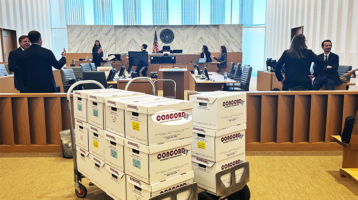
Trial prep rarely breaks down because of one dramatic error. More often, it fails at the binder level – missing tabs, inconsistent exhibit numbers, poor print quality, incomplete service sets, or a delivery that lands too late to fix. That is why a guide to trial exhibit binders matters for any legal team handling hearings, arbitrations, or trial. When the record has to be clear, the set has to be right.
What trial exhibit binders need to do
A trial exhibit binder is not just a stack of printed documents in a cover. It is a working tool for attorneys, witnesses, court staff, and opposing counsel. It needs to support fast retrieval, preserve numbering integrity, and present exhibits in a format that matches court expectations and the realities of live use.
That means the binder has to perform under pressure. Tabs should be easy to locate. Text must be legible under courtroom lighting. Bates numbers, exhibit stickers, and internal references need to align with the latest pretrial filings and exhibit lists. If your team is managing multiple sets, every copy has to match. A single mismatch can create confusion at counsel table and invite unnecessary disputes on the record.
The right approach depends on the matter. A short evidentiary hearing may call for a lean set with a clean exhibit index and only key documents. A multi-week trial may require separate witness binders, judge binders, courtesy copies, impeachment collections, and chambers sets, each with different formatting or confidentiality handling. The point is not to overbuild. The point is to produce what the case and the venue require.
CALL CONCORD TODAY (213) 745-3175 or email cs@concorddt.com
A practical guide to trial exhibit binders
The most reliable binder projects start with scope control. Before production begins, legal teams should know which exhibits are final, which are likely to change, who needs a set, and what deadline is real rather than aspirational. Many last-minute problems come from treating exhibit binders as a print job instead of a litigation workflow.
Start with the exhibit list. Confirm the numbering convention, document titles, and whether any exhibits have been withdrawn, replaced, or reserved. If there are duplicate documents with different intended uses, resolve that before tabs are created. Binder rework is expensive, but courtroom confusion costs more.
Next, decide how the sets will be used. Attorney working binders often need room for notes and may benefit from heavier stock tabs and durable binding. Judge or witness sets may need a cleaner presentation and simpler indexing. If a matter involves sealed records, trade secrets, medical files, or regulated data, access controls and labeling should be part of production planning, not an afterthought.
Then move to document preparation. This is where litigation support discipline matters. Scan quality, orientation, page size normalization, color handling, and Bates consistency all affect the final product. A contract printed from a poor scan may technically exist in the binder, but if key language is hard to read at the podium, that is a functional failure. The same goes for spreadsheets, photographs, text messages, and email threads. Some documents need oversized inserts, color printing, slip sheets, or foldouts to remain useful.
Indexing also deserves more attention than it usually gets. A good index does more than list exhibit numbers. It gives trial teams a fast route to the right document and helps confirm that every set is complete. In larger matters, it can make sense to include both a master index and section-level indices so users can navigate without flipping through hundreds of pages.
Common binder decisions that affect trial readiness
Binding format is a practical choice, not a cosmetic one. Three-ring binders make updates easier, which is valuable when exhibits are still moving. Bound books can look cleaner and prevent page drift, but they are less forgiving if last-minute substitutions come in. There is no single correct answer. The right format depends on how stable the exhibit list is and how the set will be handled in court.
Tab strategy is another area where teams either save time or create their own problems. Numeric tabs are standard, but not always sufficient. In some cases, color coding by witness, issue, or phase of examination improves speed. In others, too much visual differentiation creates more clutter than help. If multiple users will rely on the same structure, simple and consistent usually wins.
Printing choices matter more than many teams expect. Black and white may reduce cost, but it can also flatten charts, obscure annotations, or make highlighted text meaningless. Color should be used when it serves readability or evidentiary clarity, not just appearance. Paper stock, tab durability, and cover labeling also affect whether the binders survive transport and repeated handling.
Volume planning matters as well. A binder that is too full becomes hard to navigate and easier to damage. Splitting large sets into logical volumes often improves usability, especially when examination will move quickly. The trade-off is that more volumes require tighter indexing and more careful labeling. Again, the right answer depends on how the documents will be used at trial.
Where exhibit binder projects usually go wrong
Most failures happen in the final 48 hours. Exhibit numbers change after meet and confer. A ruling knocks out a category of documents. Counsel wants revised tabs. The court requests additional courtesy sets. Someone notices that one witness binder is missing key attachments. None of this is unusual. What matters is whether the production process was built to absorb change.
Another common issue is treating physical and digital preparation as separate tracks. In modern litigation, the same exhibit set may need to exist in multiple forms – printed binders for the courtroom, searchable electronic collections for counsel, and presentation-ready files for examination software. If those versions are not aligned, teams waste time reconciling discrepancies at the worst possible moment.
Chain of custody and confidentiality are also easy to underestimate. In sensitive matters, especially those involving internal investigations, government entities, healthcare records, or financial data, you need documented handling, controlled production, and clear accountability. Reliability is not only about speed. It is about being able to stand behind the process.
Working with a trial exhibit binder partner
For high-stakes matters, outside support is often less about convenience and more about risk control. A qualified production partner should understand court-facing requirements, high-volume document handling, overnight turnaround, and the interaction between paper exhibits and eDiscovery workflows. That includes being able to receive source files in varying conditions, normalize them for production, apply consistent labeling, and produce complete sets on deadline.
This is where experience shows. Teams that regularly support trial exhibit binders know how to flag practical issues before they become emergency issues. They ask the right questions about tab ranges, service copies, confidentiality designations, oversized documents, and delivery timing. They also know that a courthouse delivery window is not flexible just because the source files arrived late.
If your matter includes electronically stored information, the best support model is usually integrated. The same provider handling scanning, Bates labeling, print production, and attorney review coordination can reduce handoff errors and compress timelines. For legal departments and law firms managing complex dockets, that kind of operational continuity matters.
Concord Document Technologies supports this type of work with the production discipline legal teams expect when deadlines are fixed and exhibit integrity cannot slip.
How to build a binder process that holds up under pressure
The strongest binder workflows are simple, documented, and repeatable. Keep one confirmed exhibit list owner. Lock naming conventions early. Establish a cut-off for changes, while planning for exceptions because exceptions always come. Maintain a clear proofing step before final assembly, and verify each recipient set against the same checklist.
It also helps to think in terms of courtroom use rather than office completion. Can counsel find Exhibit 47 in seconds? Can a witness read the reproduction clearly? Will the judge receive a set that is clean, complete, and easy to navigate? If the answer is yes, the binder is doing its job.
There is always a balance between speed, cost, and flexibility. A rush build may require simpler finishing. A heavily revised exhibit list may favor ring binders over perfect-bound volumes. A lean hearing binder may be enough for one matter, while another calls for fully indexed, multi-set production with secure handling and overnight delivery. Trial teams do not need a one-size-fits-all formula. They need a process that matches the stakes, the venue, and the pace of the case.
When exhibit binders are handled with the same discipline as the rest of trial prep, they stop being a last-minute vulnerability and become what they should be – dependable tools that support the record, the argument, and the team standing up in court.