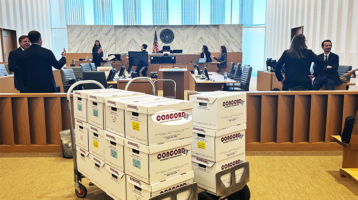
When a production deadline is hours away, Bates labeling services stop being a clerical task and become a control point for the entire matter. If numbering is inconsistent, prefixes are wrong, or image files do not match load files, the problems surface fast – during review, in meet-and-confer disputes, or at trial. For legal teams handling high-volume productions, the right process protects accuracy, defensibility, and time.
Why bates labeling services still matter
CALL CONCORD TODAY (213) 745-3175 or email cs@concorddt.com
Bates numbering remains one of the simplest ways to preserve order across large document populations. In practice, that order supports much more than page identification. It helps counsel cite documents in motions, track productions across parties, align paper records with scanned images, and prepare hearing or trial exhibits without confusion.
That sounds straightforward until the matter involves multiple custodians, rolling productions, mixed paper and ESI, and several rounds of privilege review. At that point, numbering decisions affect downstream work. A poor numbering plan can create duplicate ranges, inconsistent endorsements, and avoidable disputes over what was produced and when.
For law firms, corporate legal departments, and government agencies, this is why Bates labeling services are usually tied to broader litigation support. The numbering itself is not the hard part. The hard part is applying it correctly across scanned documents, native files, TIFF or PDF productions, slip sheets, confidentiality designations, and production logs while preserving chain of custody and meeting court or party specifications.
What strong bates labeling services actually include
Reliable service starts with a clear numbering protocol. That means determining the correct prefix, start number, digit length, placement, and any required endorsements before a single image is stamped. In active matters, teams also need to account for prior productions so new ranges do not overlap with historical sets.
A professional workflow usually includes document intake, image preparation, numbering, quality control, and production validation. If the source set includes paper, the process may begin with legal scanning and image cleanup. If the source includes electronic files, the service may also involve rendering, unitization, slip sheets for natives, and matching metadata outputs.
The key distinction is that production-grade Bates work is never just visual stamping. It is coordinated document control. The service should confirm that page counts are accurate, filenames and Bates ranges correspond, confidentiality legends are applied consistently, and produced media or uploads match the agreed format.
That matters even more in matters involving expert discovery, agency response, or trial preparation. A mislabeled set can force rework across review databases, exhibit lists, and deposition prep materials. The labor cost of fixing the problem later is usually far higher than doing the numbering correctly at the start.
CALL CONCORD TODAY (213) 745-3175 or email cs@concorddt.com
Where legal teams run into trouble
The most common issue is assuming all document sets can be treated the same way. They cannot. Paper records, oversized exhibits, color source materials, spreadsheets produced natively, and email families each require different handling. A service provider that understands litigation workflows will flag those differences before production goes out.
Another problem is fragmented vendors. One provider scans documents, another handles eDiscovery processing, and someone else applies final labels for trial or production. That split can work on smaller matters, but it often introduces version confusion and handoff errors on larger cases. When numbering has to line up across physical and electronic records, centralized control is more dependable.
Timing creates its own risks. Last-minute productions leave little room for remediation if a numbering gap or duplication appears after the fact. Legal operations teams know that overnight turnaround only helps if the quality control is equally disciplined. Speed without validation is not a service advantage.
There is also the confidentiality issue. Protective order designations, redaction labels, and attorney review decisions must align with the stamped output. If those elements are added inconsistently, the record becomes harder to defend. In regulated or high-profile matters, that is not a minor production flaw. It is a credibility problem.
Bates labeling services in paper and electronic matters
Many buyers think about Bates numbering as part of image production only. In reality, it often sits at the intersection of paper handling and digital review. A matter may begin with banker boxes, department files, medical records, or internal binders that require onsite or offsite scanning. Once digitized, those records need numbering that stays consistent through review and final production.
Electronic matters add another layer. Numbering may need to be coordinated with load files, extracted text, family relationships, and native placeholders. If documents will be reviewed in a platform such as RelativityOne, the production team must ensure that the visual labels, metadata fields, and export structure all agree.
This is one reason experienced providers are valuable on complex engagements. They understand that the output is not just a stack of stamped pages. It is a production package that may be reviewed by outside counsel, challenged by opposing parties, or carried into a courtroom.
What to look for in a provider
The first test is whether the provider speaks the language of litigation support, not just document reproduction. Legal buyers should expect operational specificity. Ask how the provider handles rolling Bates ranges, native file slip sheets, oversized documents, redactions, privilege sets, and confidentiality endorsements. If the answers are vague, the service probably is too.
The second test is production capacity. High-volume matters need a team that can scale without losing control. That includes staffing, equipment, after-hours capability, and documented quality checks. A provider serving law firms, corporations, and public agencies should be able to manage both routine productions and urgent deadlines.
The third test is security and custody discipline. Sensitive records should move through a documented workflow with restricted access and clear handling procedures. This is especially relevant when Bates labeling is part of a larger engagement involving forensic collections, attorney review, or records with regulatory implications.
It also helps to work with a provider that can bridge physical and electronic workflows under one roof. That reduces handoffs and gives legal teams a single point of accountability. For many institutions, that matters as much as price because production errors create downstream legal costs that are hard to recover.
Why integration matters more than stamping alone
In active litigation, Bates numbers touch almost every stage after collection. They show up in review references, deposition exhibits, privilege logs, expert materials, and trial binders. If numbering is inconsistent, each of those workstreams absorbs friction.
That is why the service works best when integrated with scanning, copying, eDiscovery processing, online review, and exhibit preparation. A provider with that range can carry document control from intake to final presentation. For example, paper exhibits scanned and numbered early in the case can later be repurposed for court-ready binders without resetting the reference structure.
This kind of integration is especially useful for matters under tight timelines. Southern California litigators dealing with courthouse filing and exhibit deadlines know that document preparation often compresses into the final 24 to 72 hours. In those moments, institutional production capability matters. Concord Document Technologies has built its reputation on exactly that kind of executional certainty since 1996.
When standard numbering is not enough
Some matters need more than a basic stamp in the lower right corner. Multi-party litigation may require custom prefixes by producing party or custodian. Internal investigations may need separate numbering conventions for collected records versus final productions. Trial teams may also need exhibit labels that coexist with Bates ranges without obscuring key content.
There is no single best approach for every case. The right protocol depends on production format, governing agreements, and how the documents will be used later. A dependable provider should be willing to advise on the trade-offs. A compact numbering scheme may look cleaner, for example, but longer fixed-digit formats can reduce confusion across rolling productions.
That practical judgment is what legal teams are really buying. Not just labeling, but production discipline.
The business case for getting it right
Accurate Bates work reduces review friction, avoids re-production, and supports cleaner communication with outside counsel, clients, and courts. It also protects internal teams from wasting hours reconciling inconsistent references across productions and exhibits.
For procurement and operations leaders, the value is straightforward. A qualified provider lowers execution risk on document-heavy matters. For attorneys and paralegals, the benefit is equally clear. When the numbering is right, the documents are easier to cite, easier to challenge, and easier to present.
In legal services, small errors rarely stay small. Bates labeling is one of those functions that seems minor until the case depends on it. If your matter involves volume, sensitivity, or deadline pressure, expert handling is not an extra. It is part of keeping the record usable when it counts.