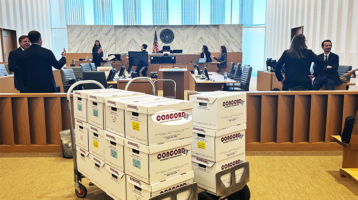
When a hearing date is firm and the record is still moving, trial binders printing for Stanley Mosk Courthouse becomes a production issue, not a clerical task. Counsel needs exhibit sets that are complete, clearly labeled, easy to handle in court, and delivered without guesswork. At that stage, speed matters, but accuracy matters more.
Stanley Mosk matters often involve compressed timelines, multiple departments, and last-minute revisions that can break a binder set if the production process is weak. A missing declaration, an incorrect tab sequence, or an exhibit list that does not match the final set can create avoidable problems for the trial team. That is why experienced legal support workflows treat binder production as part of trial readiness, not an afterthought.
What trial binder production needs to accomplish
A proper court-ready binder does more than hold paper. It has to support attorney use in live proceedings, keep exhibits organized under pressure, and reduce the risk of confusion when the court, opposing counsel, and internal teams are all working from related but distinct sets.
For Stanley Mosk filings and appearances, that usually means consistent tabbing, clean image quality, reliable pagination, and enough quality control to catch conflicts before the binders leave production. If the case includes mixed source material, such as scanned records, native-file printouts, deposition excerpts, and color exhibits, production has to normalize those materials into one coherent set.
That is where many vendors fall short. Commercial print shops can print documents, but trial binder work requires litigation judgment. The team assembling the binders needs to understand exhibit numbering, courtesy copy expectations, privilege sensitivity, and the practical difference between a presentable set and a set that actually works in court.
Trial binders printing for Stanley Mosk Courthouse is deadline-driven
There is no value in a beautiful binder that arrives late. In active litigation, timing controls almost every decision, including whether the team has time for a final QC pass, whether revised exhibit lists can be incorporated, and whether delivery windows line up with the court schedule and counsel availability.
A dependable production workflow starts with intake discipline. Final files need to be checked for completeness, naming consistency, orientation issues, missing pages, and print limitations before assembly begins. If those issues are identified only after printing, the job slows down and the risk of error rises. For trial teams, that means more than inconvenience. It can affect hearing preparation and attorney confidence.
The strongest providers build for revision. They assume some documents will change, some tabs will shift, and some sets will need different handling. A chamber copy may not be identical to attorney working binders. Opposing counsel sets may require a different label or cover treatment. That flexibility is not extra service. It is standard for serious trial support.
Accuracy is not just about print quality
Print clarity matters, especially for exhibits with signatures, annotations, spreadsheets, or photographs. But in legal production, accuracy also means document integrity. The right document must appear behind the right tab, in the right order, with the right designation and the right copy count.
That sounds obvious until a case file includes overlapping drafts, revised exhibit indexes, and materials coming from several people at once. Production breaks down when no one controls versioning. A professional legal document team solves that by reconciling source files before printing and by maintaining a clear chain from approved electronic set to finished physical binders.
If the matter is sensitive, confidentiality controls matter just as much. Many cases require disciplined handling of sealed records, personnel files, medical information, or regulated business documents. Those jobs should be managed by a bonded and insured provider with processes designed for legal records, not general office output.
What to look for in a provider handling Stanley Mosk trial binders
The first question is whether the provider understands courthouse-driven legal production. That includes same-day and overnight execution, but it also includes the judgment to flag inconsistencies before they become expensive mistakes. Experienced litigation support teams know that a production vendor should not simply follow instructions mechanically when something appears off.
The second question is capacity. Trial preparation rarely happens in a calm, evenly paced schedule. Jobs stack up at the end. If your provider cannot absorb large copy counts, multiple binder sets, color sections, late file swaps, and coordinated delivery, you are taking on risk you do not need.
The third question is service integration. Many firms are managing both paper exhibits and electronic review at the same time. A provider that can support scanning, Bates labeling, online attorney review, digital printing, and exhibit production under one roof reduces handoff errors. It also gives your team one accountable point of contact when the schedule tightens.
This is especially important when trial materials are being built from broader discovery workflows. If documents originated in hosted review, onsite scanning, or forensic data collection, the production team should be able to move from electronic source records to printed exhibit sets without losing control of formatting or metadata-related context. It depends on the case, but for complex matters, disconnected vendors create friction.
Common pressure points in trial binders printing for Stanley Mosk Courthouse
Late changes are the obvious problem, but they are not the only one. Mixed paper sizes, oversized exhibits, poor scans, inconsistent Bates ranges, and duplicate numbering all slow down final assembly. If those issues are not identified early, the legal team ends up making rushed judgment calls at the worst possible time.
Color is another trade-off. Not every exhibit needs color printing, and not every budget supports full-color sets across all binders. But some records lose meaning in black and white, particularly photos, highlighted markups, charts, or records where color is part of the evidentiary value. A good provider helps teams decide where color is necessary and where black and white is sufficient.
Binder format also depends on use. Some attorneys prefer heavily tabbed, indexed working binders with extra note space. Some hearings call for leaner, faster-reference sets. A judge copy may need a cleaner presentation than a trial team internal set that is expected to be marked up. The right answer is not always the most elaborate binder. It is the one that fits the proceeding.
Delivery is part of the job
For court-facing production, delivery should never be treated as a separate afterthought. The same discipline used in document assembly should carry through to packaging, labeling, and transfer. If a set is split across boxes without a clear sequence, or if delivery instructions are vague, even accurate binder work can become unreliable at the last step.
That is why experienced legal support providers build delivery into the workflow from the beginning. Overnight delivery to Stanley Mosk and other major courthouses, coordinated handoff timing, and confirmation protocols matter because legal teams need certainty, not assumptions. In high-stakes matters, the question is not whether a package was sent. The question is whether the correct set reached the correct destination in usable condition and on schedule.
Why institutional buyers use specialized legal document teams
Law firms, corporate legal departments, and government agencies are not looking for generic print capacity. They are looking for controlled execution. The work often includes sensitive records, hard deadlines, and a record of accountability that may need to stand up to internal scrutiny.
That is where an experienced provider such as Concord Document Technologies earns its place. The value is not only in printing and binding. It is in combining legal copying, exhibit production, scanning, attorney review support, and document handling discipline into one production environment built for litigation. For teams managing serious matters, that model reduces rework and protects time.
A capable provider should also know when to push back. If a source set is incomplete, if a tab sequence conflicts with the exhibit list, or if a requested turnaround creates preventable quality risk, the right partner says so early. That is not friction. That is professional support.
The practical standard for trial binders printing at Stanley Mosk is simple. The binders should arrive on time, match the approved record, hold up in use, and let counsel focus on the case instead of the paper. If your current process cannot promise that under pressure, it is time to call the experts before the next deadline makes the decision for you.
The best trial support is often invisible once court begins, and that is exactly the point.