When a hearing date is set at Stanley Mosk, binder prep stops being an administrative task and becomes a deadline-driven litigation function. Trial binders for Stanley Mosk Superior Court need to be accurate, court-ready, and delivered without gaps in pagination, tabs, exhibit references, or service copies. For firms handling complex matters, the binder itself is often the final checkpoint between a well-prepared case and preventable courtroom friction.
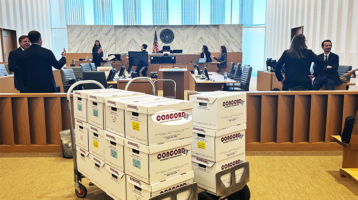
Concord can print large volume of exhibit binders overnight and deliver to Stanley Mosk Superior Courthouse the next day. Just call (213) 745-3175 .
Stanley Mosk is not the place for improvised production. High-volume civil calendars, demanding timelines, and multiple copy sets mean small mistakes create outsized problems. A missing exhibit, misnumbered tab, or unreadable scan can affect attorney flow in court and create avoidable pressure on litigation support staff.
What court-ready trial binders actually require
A proper trial binder is more than a stack of printed pleadings behind numbered tabs. In practice, it has to support the way attorneys, paralegals, courtroom staff, and clients use the record under time pressure. That means consistent indexing, clear tab structure, legible reproduction, accurate exhibit labeling, and assembly that holds up through transport and repeated handling.
For Stanley Mosk matters, there is usually more than one audience for the set. The court may need one version, opposing counsel another, and the trial team several internal working copies. Those versions may look similar, but they are not always identical. Some need full exhibits, some require courtesy formatting, and some need supplemental materials inserted at the last minute. That is where disciplined production matters.
The strongest binder workflows start with source control. If the documents coming into production are spread across emails, scanned hard copy, shared drives, and late-filed PDFs, the risk is not just delay. The larger risk is inconsistency. A reliable provider builds the binder from verified source files, tracks revisions, confirms final exhibit order, and applies the same production standards across every set.
Trial binders for Stanley Mosk Superior Court demand speed and control
Speed is part of the job, but uncontrolled speed is where errors start. Legal teams often call for binder support when filings are still changing, witness materials are still being finalized, or deposition designations are still being negotiated. The provider handling trial binders for Stanley Mosk Superior Court has to be set up for live litigation conditions, not just standard copy work.
That means having production capacity for same-day updates, overnight delivery, after-hours assembly, and last-minute copy increases. It also means understanding how litigation teams actually work. Attorneys may send changes in batches. Paralegals may need a revised tab list after business hours. Operations staff may need delivery confirmation before the courthouse opens. If the production team cannot absorb those realities, the burden shifts back to the law firm.
There is a trade-off here. The fastest turnaround is not always the cheapest path, and the cheapest path is rarely the safest one for active trial support. For high-stakes matters, most firms are not buying paper and tabs. They are buying certainty, accountability, and a production team that can execute under compressed timelines.
Common pressure points in binder production
The most frequent problems are predictable. Exhibit lists change late. Native files need to be converted and printed consistently. Bates ranges do not align with attorney references. Courtesy copies need different formatting from working binders. A witness set suddenly requires additional tabs and duplicate volumes.
None of those issues are unusual. What matters is whether the production process is built to handle them without restarting the job or introducing version confusion. Experienced legal document teams know how to isolate changes, update indexes cleanly, and maintain control over multiple sets moving at once.
Why integrated document support matters
Many trial teams still split work across vendors – one for scanning, one for printing, one for eDiscovery, and another for messenger delivery. That can work on smaller matters, but it often creates avoidable handoff risk when the case is document-heavy or deadline-sensitive. Trial binder production becomes much more reliable when the same provider can manage the upstream document workflow as well.
If records were scanned, OCR processed, Bates labeled, and reviewed through one coordinated process, final binder assembly is faster and cleaner. There is less time lost reconciling versions, rechecking page counts, or hunting for the final signed declaration. For matters involving electronically stored information, the gap between digital review and physical courtroom sets can be a real operational problem unless one team owns the workflow from intake through final production.
That is especially true when sensitive records are involved. Confidential business records, agency files, personnel records, medical documents, and regulated materials require secure handling throughout the production chain. Bonded and insured support, chain-of-custody discipline, and controlled document management are not marketing extras in this environment. They are part of basic risk control.
What legal teams should expect from a binder partner
A serious provider should be able to support more than assembly. The standard should include document intake, scanning, blowbacks from electronic files, color and oversized exhibit handling, tab creation, index generation, Bates application where needed, and coordinated delivery to Stanley Mosk. If the provider cannot manage both hard-copy and digital source materials, delays usually show up during the final rush.
Communication matters just as much as production. Litigation teams need direct status updates, not vague assurances. They need someone who will confirm file receipt, identify production issues early, and escalate immediately when a source document is missing or unreadable. In high-pressure trial preparation, silence is usually interpreted correctly – something is off.
The best support teams also understand that not every matter needs the same build. A short law and motion hearing may require a straightforward courtesy binder. A major civil trial may require multiple exhibit volumes, witness-specific sets, argument binders, and replacement pages staged for overnight updates. It depends on the case posture, the court’s expectations, and how the trial team intends to use the material.
Practical details that make a difference in court
Professional binder production is often judged by small details. Tabs should be durable and readable. Printing should be consistent across scanned and native-source documents. Volumes should be split logically, not just by page count. Indexes should match actual tab order. If a key exhibit includes color, the color should be reproduced accurately where it matters.
Delivery discipline is equally important. For Stanley Mosk matters, timing and destination accuracy are not minor logistics. They are part of trial readiness. A provider should know how to coordinate courthouse delivery, law office delivery, and additional copy routing without forcing the legal team to manage each handoff manually.
A stronger standard for high-stakes matters
For firms, agencies, and in-house legal teams managing serious litigation, trial binder work should be treated as a controlled legal support function, not overflow copy work. That is why experienced providers build around production strength, confidentiality, and around-the-clock responsiveness. When a matter is active, there is no practical value in a vendor that only performs well during normal business hours.
Concord Document Technologies supports these workflows with the kind of institutional production capacity legal teams rely on when deadlines tighten – scanning, legal copying, exhibit preparation, forensic collection support, attorney review coordination, and trial binders delivered overnight for Southern California courts including Stanley Mosk. That combination matters because trial prep rarely stays in one lane. Physical and electronic records usually meet in the same deadline.
For legal professionals, the right question is not simply who can print a binder. It is who can take ownership of the process, protect accuracy under pressure, and deliver material that is ready for court the first time. When the hearing is approaching and revisions are still coming in, that level of execution is what keeps the case team focused on the argument instead of the assembly table.
If your matter is headed to Stanley Mosk, treat the binder like the litigation tool it is. The firms that stay ahead are the ones that build production certainty into trial preparation before the last filing lands.